Showing posts with label money laundering. Show all posts

Sunday, June 2, 2013

U.S. Shuts Liberty Reserve Currency Exchange

By Jon Matonis
Forbes
Tuesday, May 28, 2013

http://www.forbes.com/sites/jonmatonis/2013/05/28/u-s-authorities-close-another-digital-currency-exchange

In conjunction with Costa Rican authorities and Spanish police, U.S. law enforcement participated in a joint operation on Friday to arrest the founder of Liberty Reserve S. A., a private digital currency exchange service based in Costa Rica.

U.S. authorities accused the currency exchange of facilitating $6 billion worth of money laundering, calling it a “bank of choice for the criminal underworld.”

Today, the website domain is resolving again but a notice on the homepage states: “THIS DOMAIN NAME HAS BEEN SEIZED by the United States Global Illicit Financial Team.” Domain names were also seized for asianagold.com, exchangezone.com, moneycentralmarket.com and swiftexchanger.com most likely for their affiliation with Liberty Reserve.

According to the indictment unsealed today, U.S. prosecutors said that the case involved law enforcement agencies in 17 countries and “is believed to be the largest international money laundering prosecution in history.” This latest action follows the 2007 closure of Doug Jackson’s famous e-gold service and this month’s seizure of Mt. Gox’s assets and account facility at U.S.-based Dwolla.

Arthur Budovsky, 39, a former U.S. citizen and naturalized Costa Rican of Ukrainian origin, was arrested in Spain and U.S. officials are likely to seek his extradition. He has been under investigation in Costa Rica since 2011 for suspicion of money laundering and for using various shell companies to operate Liberty Reserve.

On Friday, San José prosecutors raided Budovsky’s home and offices in Escazú and Santa Ana, southwest of San José, and in the northern province of Heredia. Agents from the organized crime unit of the Costa Rican Prosecutor’s Office seized documents, computers, three Rolls Royce and Jaguar automobiles, and a motorcycle. A Russian national with the last name Chukharev was also arrested and the U.S. is seeking his extradition as well.

Costa Rica state prosecutor José Pablo Gonzalez said that Costa Rica’s financial regulator, Financial Institution Superintendency (SUGEF), had refused to issue a license to Liberty Reserve in 2011 due to concerns about its transparency and funding procedures.

Investigators allege that Budovsky’s businesses in Costa Rica were used to launder funds from drug trafficking, identity theft, and pornography websites. The seized digital and physical evidence from the companies will be turned over to U.S. law enforcement in accordance with “international penal assistance.” The involved companies are Silverhand Solutions & Technology S.A. (Santa Ana), Worldwide E-Commerce Business S.A., or WEBSA (Escazú), Grupo Lulu Limitada (Escazú), Triton Group A & A, S.A. (Escazú), and Cyberfuel.com (Santa Ana).

Some Liberty Reserve users are estimating that the company may have held customer funds in excess of $150 million at the time of the seizure. There has been no statement from authorities on the reclamation process.

Since 2002, Liberty Reserve had been operating one of the oldest and most popular payment processors in the world with millions of clients. Vitalik Buterin of Bitcoin Magazine credits the company with being “one of the chief enablers of the Bitcoin economy’s early growth.” Payment methods such as credit cards and ACH transfers are not a great match for the irreversible bitcoin, because those payment methods can be reversed, or charged back. In 2010 and 2011 with the bitcoin exchanges struggling for irreversible inbound payment methods, Liberty Reserve Dollars and Liberty Reserve Euros were proprietary digital units that satisfied the need for payment finality.

Although security researcher Brian Krebs emphasizes the more salacious cyber crime aspects of the case, Liberty Reserve was also utilized by many legal businesses.

According to Forex Magnates, Liberty Reserve was “the leading payment channel for traders in emerging and frontier markets” and it was used by several international forex brokers, such as Marketiva, FXOpen, Markets.com, and Instaforex. Citing Masroor Ghoori, a foreign exchange broker in Pakistan, Forex Magnates said, “Forex brokers have been benefiting from Liberty Reserve’s vast access as a payment provider, especially in countries where traders face difficulties in transferring funds. Liberty Reserve was a ‘gift’ for several traders, especially after the State Banks’ (State Bank of Pakistan) changes to international money transfers.”

In a separate report, Forex Magnates predicts that bitcoin may be a viable alternative for payments to introducing brokers and even direct forex account funding now that centralized systems are under attack.

Mitchell Rossetti, co-founder of virtual prepaid ePay Cards, told the BBC that his company now faces an “uphill battle” to make up potentially lost funds because his business had about $28,000 sitting in a Liberty Reserve account at the time the site went offline. The cards allow consumers outside the U.S. to purchase goods from stores in the country as if they owned a locally-issued Visa or Mastercard credit card. Based in Texas and London, the firm allowed its customers to load their virtual prepaid cards with Liberty Reserve because it was quick, efficient and secure.

Demonstrating that those most harmed in targeted digital currency shutdowns are law-abiding U.S. citizens, Panamanian payment system Perfect Money announced the following on Saturday:

"Due to changes in our policy we forbid new registrations from individuals or companies based in the United States of America. This includes US citizens residing overseas. If you fall under the above mentioned category or a US resident, please do not register an account with us. We apologize for inconvenience caused."

Sunday, May 12, 2013

Money Laundering Is Financial Thoughtcrime

By Jon Matonis
American Banker
Tuesday, May 7, 2013

http://www.americanbanker.com/bankthink/money-laundering-is-financial-thoughtcrime-1058902-1.html

When people hear the term money laundering today, they envision the most evil of acts, in which gangsters process satchels of cash through a fabricated company to show it as business revenue. Words and semantics are very important in this post-9/11 world, and as far as creating a negative connotation, that parlance has been extremely effective.

At its essence, money laundering is the act of concealing money or assets from the state to prevent its loss through taxation, judgment enforcement, or blatant confiscation. However, as the late J. Orlin Grabbe wrote: "Anyone who has studied the evolution of money-laundering statutes in the U.S. and elsewhere will realize that the 'crime' of money laundering boils down to a single, basic prohibited act: Doing something and not telling the government about it."

Protecting one's wealth is interwoven with the history of trade and banking which has existed since the dawn of commerce. Sterling Seagrave's Lords of the Rim describes how some 2,000 years before Christ, merchants in China would hide their wealth from rulers who would simply take it from them and subsequently banish them. This concealment involved moving the wealth and investing it in remote provinces or outside China.

Part myth, part rumor, the plausible tale of Mafia gangsters running huge amounts of cash from extortion, prostitution, gambling and bootleg liquor through existing Laundromats accounts for the phrase money laundering.

Also during this period, Al Capone was convicted in October 1931 for tax evasion, which is what earned the prosecutor's conviction rather than the predicate crimes that generated his illicit income. Capone's episode inspired Meyer Lansky, the mob's accountant, who structured elaborate international and Swiss financial facilities for safely securing money and vowed never to suffer Capone's fate.

Lansky is credited with designing one of the first real laundering techniques, the use of the "loan-back" concept, which disguised allegedly illegal money within "loans" provided by compliant foreign banks. The money could then be justified as revenue and a tax deduction for interest expense obtained in the process.

Without any method of tracking cash or bank activity, Congress passed the Bank Secrecy Act in 1970, heralding the age of transaction reporting, including the Currency Transaction Report (Form 4789), the Report of International Transportation of Currency or Monetary Instruments (Form 4790), and the Report of Foreign Bank and Financial Accounts (Form TD F 90-22.1). In the United States, the Money Laundering Control Act formally made money laundering a federal crime.

Internationally, the elements of the crime of money laundering are set forth in the United Nations Convention Against Illicit Traffic in Narcotic Drugs and Psychotropic Substances and Convention against Transnational Organized Crime. Also, the Financial Action Task Force on Money Laundering, founded in 1989 on the initiative of the Group of Seven industrialized nations, is an intergovernmental organization whose purpose is to develop policies to combat money laundering and terrorism financing.

From President Roosevelt's 1933 seizure of personal gold to the Nazi confiscation of Jewish wealth to the recent deposit theft at Cyprus banks, asset plundering by governments has a long and colorful tradition. Protecting wealth from oppressive regimes continues to this day.

It's highly political and also a matter of perspective whether protection from confiscation is a justifiable activity. Government access to wealth is at the heart of the issue and it matters not if it's hiding money or cleaning money.

Therefore, the artificial crime of "money laundering" had to be invented, mainly because more direct and traditional methods of enforcing certain laws yielded little result. Think of it as driving without a light bulb above the license plate being a felony because thieves might drive away in the night. All must participate in illuminating the way to be tracked. More than anything, this is a clear sign of regulatory desperation.

Money laundering has been called the thoughtcrime of finance. Isn't it really just banking with someone's possibly nefarious intentions attached to the act? It's like buying a drive-thru donut in a stolen vehicle. The theft of the vehicle may have been illegal and immoral but the act of purchasing a donut is not. Money laundering is not pre-crime but post-crime. And, it's difficult to identify the victim, other than the bank shareholders that must expend millions of dollars for the proactive compliance required as the state's deputized enforcers.

Moreover, money laundering is guilt by association. If the monetary flows resulting from associated businesses are deemed illegal, then the banking activity is defined as money laundering. But, in the absence of victimless crime laws against drugs, gambling, and prostitution, the majority of banking labeled as money laundering would simply be banking.

According to the International Money Laundering Information Bureau, "Money Laundering is also the world's third-largest industry by value." Apparently, it happens in every country in the world. Well, breathing by humans also happens in every country in the world. If money laundering is actually the third-largest industry in the world then it's either being calculated wrong or it's too easily defined.

In his Rolling Stone article "Gangster Bankers: Too Big to Jail," Matt Taibbi mocks the anti-money-laundering regime as being hypocritical because large commercial banks like HSBC receive a light slap on the wrist and the blind-eye treatment as smaller fish are routinely scooped up in the net. Taibbi correctly distinguishes between an arrestable class and an unarrestable class. However, he misses the point of the law's arbitrariness in the first place. Thank you for the analysis, Mr. Taibbi, but dispensing enforcement of an immoral law more evenly is not a solution for justice.

Even as the money-laundering laws are said to exist for the fight against terrorism or drugs or gambling, the cashless utopia is simultaneously being thrust upon us as the monetary architecture of the future. Expect ever more increasing thoughtcrime enforcement as the international money flow tightens.

Wednesday, May 1, 2013

Patrick Murck Discusses Bitcoin With Financial Crime Specialists

General Counsel at the Bitcoin Foundation and VP of Business Development and General Counsel at CoinLab, Patrick Murck, recorded a podcast on April 26th, 2013 with the Association of Certified Financial Crime Specialists, a group connecting the global financial crime community. The talk was entitled: "Bitcoin’s promise and perils: What financial institutions should know about the new virtual currency."

From the ACFCS website:

Until recently, the virtual currency of Bitcoin may have had almost as many critics, skeptics and naysayers as it had actual users. Much has changed in the past few months. With the value of Bitcoins exploding, its exchanges doing a lively business, and more and more merchants accepting it as payment, Bitcoin now seems close to fulfilling its potential as a widely used, decentralized online currency.

One thing that has not changed, however, are the concerns over money laundering and financial crime risks that have swirled around Bitcoin since its inception. To delve into the mechanics of the online currency and explain how it interfaces with financial institutions worldwide, ACFCS is joined by Patrick Murck, General Counsel of the Bitcoin Foundation, on this Financial CrimeCast. He explains the inner workings of Bitcoin, and describes what steps the currency and its exchanges are taking to mitigate financial crime risks.

He also analyzes the impact of recent guidance by the US Financial Crimes Enforcement Network that lays out suggested regulations for virtual currencies for the first time, and explains what financial institutions should know about doing business with Bitcoin users.

Tuesday, April 30, 2013

Fincen's New Regulations Are Choking Bitcoin Entrepreneurs

By Jon Matonis
American Banker
Thursday, April 25, 2013

http://www.americanbanker.com/bankthink/fincen-regulations-choking-bitcoin-entrepreneurs-1058606-1.html

More than a decade ago, regulators nearly suffocated PayPal. Now it looks like they’re trying to squelch another disruptive, innovative payments system.

At least three exchanges in the U.S. that traded the digital currency Bitcoin have shut down, apparently as a result of guidance issued last month by the Financial Crimes Enforcement Network. That agency has emerged as the top threat, at least in in the United States, to the decentralized Bitcoin network – moreso than the widely reported price volatility and hacker attacks.

"They've been the single biggest factor for stomping out currency competition," says Bradley Jansen, a former assistant to Rep. Ron Paul and director of the Center for Financial Privacy and Human Rights. Speaking recently on The Daily Bitcoin podcast with Adam Levine, Jansen expressed surprise at how little focus bitcoin business leaders are putting on Fincen, especially considering how regulators thwarted earlier emerging payment systems like PayPal and e-gold. PayPal obviously survived and prospered – but only after selling itself to eBay and agreeing to put restrictions on its service. E-gold was not so fortunate.

"Fincen was able to stop currency competition with technical innovations in the 90s even before their expanded powers under the U.S. Patriot Act. And, what we've got now is a Fincen on steroids without clear restrictions from Congress," Jansen says.

The guidance requires certain intermediaries that handle virtual currency to register with Fincen as money services businesses, which entails recordkeeping and reporting responsibilities. And it says some of those businesses may additionally be money transmitters, which would mean fingerprinting of directors and officers and compliance with a patchwork of state licensing requirements.

Jansen postulates that the recent Fincen virtual currency guidance was issued ex post facto as a way to set the stage for potential prosecutions in the future.

"It's a failure of Congress to do its job. We knew that these guidelines and these prosecutions were in the works even last Congress. Ron Paul was the chairman of the House subcommittee that had jurisdiction over Fincen and he never had a single hearing on this."

In a recent speech, Fincen Director Jennifer Shasky Calvery said the new guidance aims "to protect [digital currency] systems from abuse and to aid law enforcement in ensuring that they are getting the leads and information they need to prosecute the criminal actors." She reiterated that the guidance does not apply to everyday users who pay or accept bitcoin for goods and services.

But by saddling startups with compliance requirements, and making them unattractive clients for regulated banks that despair of serving MSBs, Fincen is choking these businesses that facilitate conversion of bitcoins into dollars. Fewer exchanges and more red tape will make it harder for merchants or consumers (who, after all, must still pay the bills with dollars) to take advantage of the Bitcoin payment system’s speed, privacy and competitive costs.

On March 20 – just two days after the guidance from Fincen came out – the bitcoin exchanger bitme.com suspended operations indefinitely. Bitme was a relatively small operation, but it was widely suspected among bitcoin users in online forums that this closure resulted from difficulties related to potential regulatory compliance.

BTC Buy, another bitcoin exchange site, suspended services and closed permanently in early April, specifically citing the legal uncertainty brought up by the Fincen guidance.

Most recently, the largest bitcoin exchange to halt trading was Bitfloor, run by Roman Shtylman, who blamed "circumstances outside of our control." His New York operation had average daily trading volume of about $300,000 (depending on the exchange rate), with U.S. dollar deposits and withdrawals running through a Capital One bank account – which the bank unilaterally closed.  "I had very little time to act between receiving the account closure letter and the account being closed," Shtylman told PaymentsSource.

In this case, the regulatory guidance may have had an indirect effect. Bitfloor was registered with Fincen as an MSB but was not licensed as a state money transmitter. Shtylman surmised that Capital One had judged his business to be "not worth the risk."

Across the Atlantic and presumably unrelated to Fincen, Poland-based Bitcoin-24 suspended trading after the government there froze its bank account. It reportedly did so because a bank in Germany complained of compromised accounts transferring stolen money without identification to Bitcoin-24. Also, U.K.-based TransferWise, a foreign currency intermediary, ceased transfers to any bitcoin exchanges at the request of its banking partners. TransferWise had mostly been servicing customers in the U.K., Poland, and Spain.

It will be interesting to watch how Fincen intends to treat one-way, fixed-rate brokers that either buy or sell bitcoin at a fixed price. Since a two-way exchange market is not involved it could be seen as merely a typical commodity purchase or sale.

Tangible Cryptography LLC, which registered as an MSB this month, operates FastCash4Bitcoins for selling bitcoins and Bitcoins Direct for private off-exchange purchases. The two businesses function independently of each other and neither is technically an exchange. Bitcoins Direct is frequently closed to new clients and its cash deposit feature was recently cancelled.

The fact that bitcoin survives at all with so many powerful forces lined up against it is a testament to its resiliency and tenacity. Now, in addition to the vicious press coverage and persistent denial of service attacks on exchanges, the emerging cryptographic money has to contend with onerous and targeted regulation.

With respect to bitcoin and financial regulation, Jansen warns: "I think the lesson from the 90s was that you either become what Fincen wants you to be or you're not going to be."

Not in the U.S., that is. But jurisdictional competition will kick in and overseas exchanges will gain market share and liquidity. They just may not have U.S. customers.

Wednesday, April 24, 2013

Bradley Jansen Discusses FinCEN Regulations and Bitcoin

Yesterday, Adam B. Levine, editor-in-chief of The Daily Bitcoin, interviewed Bradley Jansen for "Let's Talk Bitcoin" about the US Treasury's Financial Crimes Enforcement Network (FinCEN) and their recent guidance on alternative currencies such as Bitcoin. According to Jansen:
"What we've got now is a FinCEN on steroids without clear restrictions from Congress!"
You can listen to the entire interview here:
http://letstalkbitcoin.tumblr.com/post/48738464442/lets-talk-bitcoin-is-a-show-for-users-new-and

Bradley is editor of FreeBanking.org and Director of the Center for Financial Privacy and Human Rights. He comes on at about the nine-minute mark, but the conversation before that leads into the discussion on FinCEN.

Monday, April 22, 2013

FinCEN's Director on Virtual Currencies

By Bradley Jansen
FreeBanking.org
Saturday, April 20, 2013

http://www.freebanking.org/2013/04/20/fincens-director-on-virtual-currencies/

Earlier this week, FinCEN Director Jennifer Shasky Calvery addressed the National Cyber-Forensics Training Alliance CyFin 2013 Conference.

She explains again how the Financial Crimes Enforcement Network (FinCEN) gets its data from the reports it mandates that banks use to spy on their customers against them. Lots and lots of reports.

But she promises:
"However, right now this is long and arduous work as analysts sift through hundreds and sometimes thousands of reports. Very soon, new capacities made possible by our internal technology modernization will allow our analysts to deal with such data sets to find leads in a fraction of the time previously necessary. Very soon, we will be able to point law enforcement and other stakeholders precisely to where they should be looking. Our analysts, working hand- in-hand with our superb technology team, are now putting these new capacities into place."
But her talk really focused on "Emerging Payment Systems." Her comments have echoed mine (from an entirely different perspective) that technology (and specifically mobile apps) offer great opportunities (for free banking) and that those not well served by our current system (the "unbanked" in the US--immigrants, poor, racial and ethnic minorities--and people in countries with less mature financial systems or sound currencies) are a great target market.
"As we all know, during the past decade, the development of new market space and new types of payment systems have emerged as alternatives to traditional mechanisms for conducting financial transactions, allowing developing countries to reach beyond underdeveloped infrastructure and reach those populations who previously had no access to banking services. For consumers and businesses alike, the development and proliferation of these systems are a significant continuing source of positive impact on global commerce."
Don't worry, FinCEN is working to strangle these initiatives in their crib with their regulations. She pays special attention to "crypto-currencies" in her talk.
"We’re viewing our analytic work in this space as an important part of an ongoing conversation between industry and law enforcement. While probably most of today’s audience understands what these emerging payments systems are and how they work, many line analysts, investigators, and prosecutors in law enforcement may not, and part of FinCEN’s role is to help be the bridge to explain these new systems. FinCEN is dedicated to learning more about digital currency systems, along with other emerging mechanisms, to protect those systems from abuse and to aid law enforcement in ensuring that they are getting the leads and information they need to prosecute the criminal actors. As our knowledge base develops, in concert with you, we will look to leverage our new capabilities to identify trends and patterns among the interconnection points of the traditional financial sector and these new payment systems.
In addition to developing products to help law enforcement follow the financial trails of emerging payments methods, FinCEN also develops guidance for the financial industry to clarify their regulatory responsibilities as they relate to emerging areas."
And, as our Bitcoin fans know--at least those who follow my posts here or my rants on our Facebook page, FinCEN has "virtual currencies" in their sights. And, remember too, it was FinCEN that shut down e-gold back in the day and crippled the crypto-currency movement last century.

I'll quote her in the entirety of her virtual currency remarks:
"In fact, just last month, FinCEN issued interpretive guidance to clarify the applicability of BSA regulations to virtual currencies, such as Bitcoin, which has in recent weeks gained significant attention. The guidance responds to questions raised by financial institutions, law enforcement, and regulators concerning the regulatory treatment of persons who use virtual currencies or make a business of exchanging, accepting, and transmitting them.
FinCEN’s rules define certain businesses or individuals as money services businesses (MSBs) depending on the nature of their financial activities. MSBs have registration requirements and a range of anti-money laundering, recordkeeping, and reporting responsibilities under FinCEN’s regulations. The guidance considers the use of virtual currencies from the perspective of several categories within FinCEN’s definition of MSBs.
The guidance explains how FinCEN’s “money transmitter” definition applies to certain exchangers and system administrators of virtual currencies depending on the facts and circumstances of that activity. Those who use virtual currencies exclusively for common personal transactions like receiving payments for services or buying goods online are not affected by this guidance.
Those who are intermediaries in the transfer of virtual currencies from one person to another person, or to another location, are money transmitters that must register with FinCEN as MSBs unless an exception applies. Some virtual currency exchangers have already registered with FinCEN as MSBs, though they have not necessarily identified themselves as money transmitters. The guidance clarifies definitions and expectations to ensure that businesses engaged in similar activities are aware of their regulatory responsibilities and that all who need to, register appropriately."
The second half of her speech talked about account takeovers via malware, risks with third party payment processors, improvements they are making to their analytical work (after some false starts!), their public-private partnerships with industry, and her personal initiative "The Delta Team" ("The purpose of the Delta Team is for industry, regulators, and law enforcement to come together and examine the space between compliance risks and illicit financing risks. The goal is to reduce the variance between the two.").

And let's not forget FinCEN's dreams of global domination. They are in a partnership of 130 other "Financial Intelligence Units" as part of the Egmont Group.

The text of her remarks is available at the following link:
http://www.fincen.gov/news_room/speech/pdf/20130416.pdf

Reprinted with permission.

Tuesday, March 26, 2013

FinCEN Spying Plan Invites Privacy Workarounds

By Jon Matonis
American Banker
Thursday, March 21, 2013

http://www.americanbanker.com/bankthink/fincen-spying-plan-invites-privacy-workarounds-1057728-1.html

The dangers to financial privacy are monumental. Consider an Obama administration plan to give spy agencies unfettered access to data on American citizens and others who bank in the U.S.

Suspicious Activity Reports, filed by financial institutions that operate in the U.S., are the primary documents that the Financial Crimes Enforcement Network intends to share. The reports cover all personal cash transactions exceeding $10,000, suspected incidents of money laundering, loan fraud, computer hacking and counterfeiting.

The Treasury Department proposal, revealed by Reuters last week, aims to consolidate financial data banks, criminal records and military intelligence. This initiative will put intelligence agencies, such as the Central Intelligence Agency and the National Security Agency, on the same footing as the Federal Bureau of Investigation, which currently does not have to make case-by-case informational requests to Fincen.

Also under the new proposal, Fincen's database would be linked to the Joint Worldwide Intelligence Communications System, which U.S. defense and law enforcement agencies use to share classified information.

Money was never meant to be a method of supranational identity tracking. Its use in that way could signal some level of law enforcement desperation. When all other enforcement tactics fail, surveil the finances.

More than 25,000 financial firms, including banks, securities dealers, casinos, and money transfer agencies, routinely file "suspicious activity reports" to Fincen, according to the Reuters article. Banks and other firms tend to over-report some financial details of ordinary citizens since the requirements for filing are so strict they don't want to be accused of failing to disclose activity that later proves questionable.

Increasing encroachment against financial privacy like this Fincen move "raises concerns as to whether people could find their information in a file as a potential terrorist suspect without having the appropriate predicate for that and find themselves potentially falsely accused," Sharon Bradford Franklin, senior counsel for the Rule of Law Program at the Constitution Project, told Reuters.

One protection from becoming scooped up in a fishing expedition and being falsely accused is the use of virtual or alternative currencies. But this week, Fincen issued guidance on virtual currencies and regulatory responsibilities.

Clarifying circumstances where the "money transmitter" definition applies under the law, Fincen classified de-centralized virtual currency as a convertible virtual currency that has no central repository and no single administrator, and that persons may obtain by their own computing or manufacturing effort. Although bitcoin was not singled out by name, the guidance appears directed at cryptocurrencies that operate in a peer-to-peer, distributed fashion such as Bitcoin.

The primary impact of the likely tighter compliance will be felt by the bitcoin-to-fiat exchanges operating in the U.S. and this will lead to jurisdictional competition, as seen in online casino gambling where the more entrepreneurial jurisdictions rose to dominance by embracing the technology early and not overregulating.

Almost serendipitously, discussions about adding privacy extensions to the Bitcoin cryptographic money protocol have been increasing lately.

Bitcoin is nonpolitical money and it falls outside the scope of reporting financial institutions. Since bitcoin does not provide user and transactional privacy by default, multiple bitcoin wallets and Tor, a client software and volunteer server network that enables online anonymity, can enhance privacy without modification to the core Bitcoin code. Nonetheless, code-modifying proposals for augmenting Bitcoin privacy have been introduced. One idea calls for automatic mixing techniques, which would periodically give all users the opportunity to shuffle coins among one another, making the money harder to trace without implicating individuals. Another concept is "coin control," a method for users to select which of their wallet’s multiple addresses to use as the "from address" (currently picked somewhat randomly by the client software).

Various proposals for improving bitcoin privacy include "Patching The Bitcoin Client" (2011), "Automatic Coin Mixing" (2012), "Coin Control" (2012), and "Yet Another Coin Control Release" (2013).

Also, a recent cryptographic bitcoin privacy extension submitted by researchers from The Johns Hopkins University was accepted for presentation to the IEEE Symposium on Security & Privacy in Oakland, Calif. The paper Zerocoin: Anonymous Distributed E-Cash from Bitcoin will be introduced on day two of the May conference.

Having received a preliminary copy of the academic paper, I interviewed Hopkins research professor Matthew Green about some of the details of Zerocoin.

Operating as a decentralized layer of anonymous cash on top of the existing Bitcoin network, "Zerocoin creates an 'escrow pool' of bitcoins, which users can contribute to and then later redeem from," Green explained. Users receive different coins than they put in (though the same amount) and there is no entity that can trace your transactions or steal your money. "Unlike previous e-cash schemes, this whole process requires no trusted party. As long as all the nodes in the network support the Zerocoin protocol, the system works in a fully distributed fashion," added Green.

Zerocoin developers are working on improved efficiency because implementation is impractical today given the space constraints of the “blocks” that make up the Bitcoin public ledger. "For one thing, the transactions are very large (40kb to spend a coin)," Green said. "While this isn't the end of the world – and bandwidth is always increasing – supporting these would put quite a strain on the block chain."

When I asked Green about the possibility of a "back door" for law enforcement that had been floated recently, he clarified, "The back door isn't part of Zerocoin. There's absolutely no need for it, and building one in would take significant additional effort. In fact, we only mentioned it as a brief note in the conclusion of our paper, mostly to motivate future research work."

If someone did try to build a back door for any reason, the open source Zerocoin would quickly become Zero-adoption.

Sunday, March 3, 2013

Expect Blowback if KYC Rules Are Expanded

By Jon Matonis
American Banker
Tuesday, February 26, 2013

http://www.americanbanker.com/bankthink/expect-blowback-if-kyc-rules-are-expanded-1057055-1.html

The uncovering of an alleged $200 million credit card fraud scheme has triggered calls to expand know-your-customer rules. Those who prescribe ever-greater surveillance should be careful what they wish for.

In what was described as a sprawling criminal enterprise stretching across dozens of states and numerous countries, fabricated identities were used to obtain credit cards and doctor credit reports to borrow large amounts of money. At the heart of the alleged scheme were the merchant processor accounts used to accept and process the cards with stolen identities, authorities announced on Feb. 5. ATM withdrawals involve video surveillance and direct purchasing of merchandise doesn't yield cash. So the fraud ring allegedly used merchant accounts, mostly those of jewelry stores, since it is easier to obtain cash in a bank account using a fictitious sales transaction.

In some instances, sham companies were created and then those businesses established the direct relationship with the merchant processor and purchased the credit card terminals, the FBI said. Involving 25,000 fraudulent credit cards, 7,000 fake identities, and 1,800 "drop addresses," the conspirators allegedly wired millions overseas to Pakistan, India, the United Arab Emirates, Canada, Romania, China, and Japan.

For the duration of the probe, account information was known about the senders of international wire transfers, but not much was known about the recipients.

That is why experts are now pointing to this alleged scheme as justification for the expansion of Bank Secrecy Act and anti-money laundering regulations to include the identification and scrutiny of the recipients of funds associated with high-risk transactions.

Micah Willbrand, director of AML and compliance for LexisNexis' North American Financial Services Markets, told a trade publication, "Laws and regulations today only require that the bank have KYC [know your customer] in place for the sender, not the receiver of money."

"But card fraud schemes demonstrate why it's imperative to have KYC controls in place for both senders and recipients," he adds. As a result of the Foreign Account Tax Compliance Act, "all countries are realizing we need to know more about who's receiving the money. We need to be more transparent about how money is moving around the world, and that is something everyone is coming around to."

That is a very optimistic assumption, especially since considerable resistance already exists regarding global standardization of information-sharing. Ultimately, compliance would require a lot more legwork and due diligence on the part of banks, and financial institutions have been reluctant to move in this direction. If banks were required to replicate the current KYC controls for recipients as well as senders, the jurisdictional challenges would be complicated and expensive.

Willbrand justifies the investment cost in a subtle Risk.net advertorial “article”: "The implementation of FATCA will guide financial institutions … globally by providing them with a reference on what verification is required of their customers and the level of due diligence required from them based on their asset transfers. FATCA will, therefore, enable FIs everywhere to create a standardised customer onboarding process that will clearly define risk tolerances and accepted practices for engaging with customers."

Expanding KYC guidelines to include the recipient of funds would require a massive uniform international process that is continually monitored and updated. Additionally, the cross-border sharing of customer information could realistically lead to equally determined calls for reciprocity on the part of U.S. financial institutions. U.S. banks that act on behalf of the recipients of international funds could find themselves swarmed with overseas requests for KYC information prior to any funds transfer.

For Willbrand, it's a Big Data problem of not enough domestic and international information available to detect anomalies and potential risks earlier. Automated third-party systems are more efficient than the manual review systems in place at some banks today. Willbrand says, "Data about identities is not combined internationally. The only way to get an accurate profile is by cross-checking public records with utility bills and bank accounts around the world."

Willbrand's call for expansion of money transfer surveillance powers represents an overreach that merely attacks the symptom of the problem. Privacy and data security rules vary, and sometimes conflict, in the many jurisdictions around the world. Big Data might be the answer, but it should be Big Data at the front end, during the credit card account opening process and the determination of spending limits – not Big Data that extends privacy violations worldwide.

Monday, November 12, 2012

Department Of Homeland Security To Scan Payment Cards At Borders And Airports

By Jon Matonis
Forbes
Wednesday, November 7, 2012

http://www.forbes.com/sites/jonmatonis/2012/11/07/department-of-homeland-security-to-scan-payment-cards-at-borders-and-airports/

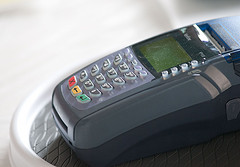
Typical wireless electronic card reader
Travelers leaving or entering the United States have long had to declare aggregated cash and other monetary instruments exceeding $10,000. Now, under a proposed amendment to the Bank Secrecy Act, FinCEN (Financial Crimes Enforcement Network) will also require travelers to declare the value of prepaid cards that they are carrying, known now as "tangible prepaid access devices."

Expected to be finalized by the end of this year, the cross-border reporting modifications stem from a broader October 2011 definition of payment methods and form factors that replaced the term "stored value" with the term "prepaid access" in an effort to more accurately describe the process of accessing funds held by a payment provider.

Enforceability falls to U.S. Immigration and Customs Enforcement and U.S. Customs and Border Protection both within the Department of Homeland Security, which is already developing advanced handheld card readers that can ascertain whether a traveler is carrying a credit card, debit card, or prepaid card. This differentiation is important because only prepaid card balances will need to be added to declaration report forms.

Acknowledging that many questions still remain and that enforcement may not be straightforward, Cynthia Merritt, assistant director of the Retail Payments Risk Forum at the Federal Reserve Bank of Atlanta, had this to say about the handheld readers:
"Furthermore, according to the comments, the enforcement challenge is not new, nor is the concept of a device or document that can be used to access value. The current challenges are similar to those presented in the past with other monetary instruments such as checks, money orders, and traveler checks."
Merritt also stated that, "When law enforcement takes possession of a cash or monetary instrument at the border, they are effectively holding the funds, but not so with a prepaid card or other device. Holding the card does not provide access to the underlying funds."

Other questions to be settled include how to determine mobile phone wallet and key fob balances that can function in a manner similar to card swiping, how to distinguish between reloadable and non-reloadable prepaid cards, how to distinguish between bank-issued and non-bank-issued prepaid cards, should closed loop gift cards be included in the cross-border reporting requirements, what to do about cards that clear customs with a minimal balance but are then subsequently reloaded with an amount in violation of the reportable limits, and what to do about a large number of nonpersonalized, unembossed cards.

Also, would a traveler have legal recourse for damages if agents seized a proper debit card in the mistaken belief that it was a reportable prepaid card?

These complications and others imply that FinCEN's NPRM [Notice of Proposed Rule Making] may yet undergo some revisions in order to bring the regulations in sync with the realities of the prepaid card industry.

In the meantime, travelers with a memorized Bitcoin private key can breathe a sigh of relief, because according to an important April 9th, 2012 letter to FinCEN Director James Freis from Homeland Security Investigations it appears that intangible brainwallets are safe for the moment:
"Should the border declaration apply to codes, passwords and other intangibles as well as to any tangible object that is dedicated to accessing prepaid funds?"
"HSI believes that border declaration should not apply to codes, passwords and other intangibles. Identification and verification of intangibles in the context of border enforcement poses logistical and potential legal issues that are not contemplated by currency and monetary instrument declaration regulations. The structure of the currency and monetary instruments declaration regime, hinges on the existence of a physical object. The language requires something that can be passed from one individual to another in order to be presented to a third party for execution/payment."

Monday, October 22, 2012

Large Cash Transactions Banned In Mexico

By Jon Matonis
Forbes
Wednesday, October 17, 2012

http://www.forbes.com/sites/jonmatonis/2012/10/17/large-cash-transactions-banned-in-mexico/

Outgoing Mexican President Felipe Calderon has signed into law a ban on large cash transactions. The ban will take effect in about 90 days and it is part of a broader effort to control monetary flows within the country.

Under the law, a Specialized Unit in Financial Analysis operating within the Attorney General's Office will be created to investigate financial operations "that are related to resources of unknown origin."

For real estate transactions, cash payments of more than a half million pesos ($38,750) will be forbidden and, for automobiles or items like jewelry, art, and lottery tickets, cash payments of more than 200,000 pesos ($15,500) will be forbidden. The law carries a minimum penalty of five years in prison.

In 2010, Mexico instituted strict limits on foreign exchange cash transactions to $1,500 per person per month, which caused several cash dollar exchanges to withdraw from the business and had the effect of penalizing tourists.

Of course, US dollars are a huge portion of the actual paper cash that this effort is aimed at, but the Mexican peso is the 12th most traded currency in the world and by far the most traded currency in Latin America.

Reuters reported that, "Sales of drugs from marijuana to cocaine and methamphetamine in the United States are worth about $60 billion annually, according to the United Nations. About half of that amount is estimated to find its way back to cartels in Mexico."

The Woodrow Wilson International Center For Scholars' Mexico Institute published a comprehensive study in May 2012 entitled "It's All about the Money." The report recommended tight integration and coordination with the United States in the areas of legal framework, financial institution regulation, intelligence on cross-border currency flows, and non-conviction based asset forfeiture.

Two years in the making, the new law also requires notaries, real estate brokers, and other dealers to report the forms of payment for transactions above the respective limits. Financial institutions will also be required to report monthly credit card balances in excess of 50,000 pesos ($3,875).

Although it's part of a global trend among governments, Mexico will still have a long way to go to catch up. Spain recently banned cash transactions above 2,500 euros and Italy banned cash transactions above 1,000 euros.

Monday, September 17, 2012

Key Disclosure Laws Can Be Used To Confiscate Bitcoin Assets

By Jon Matonis
Forbes
Wednesday, September 12, 2012

http://www.forbes.com/sites/jonmatonis/2012/09/12/key-disclosure-laws-can-be-used-to-confiscate-bitcoin-assets/

Gaol time at the Justice and Police MuseumJail time for refusing to comply with mandatory key disclosure hasn't occurred in the United States yet. But, it's already happening in jurisdictions such as the UK, where a 33-year-old man was incarcerated for refusing to turn over his decryption keys and a youth was jailed for not disclosing a 50-character encryption password to authorities.

Similarly harsh, key disclosure laws also exist in Australia and South Africa which compel individuals to surrender cryptographic keys to law enforcement without regard for the usual common law protection against self-incrimination.

Key disclosure laws may become the most important government tool in asset seizures and the war on money laundering. When charged with a criminal offense, that refers to the ability of the government to demand that you surrender your private encryption keys that decrypt your data. If your data is currency such as access control to various amounts of bitcoin on the block chain, then you have surrendered your financial transaction history and potentially the value itself.

These laws will impact not only money laundering prosecution but almost any asset protection strategy that attempts to maintain an element of financial privacy such as private banking or family trusts. Prior to all these money laundering laws being enacted, I once heard it said that the practice of moving money around was simply referred to as banking.

Doug Casey famously said that "it's a completely artificial crime. It wasn't even heard of 20 years ago, because the 'crime' didn't exist." Furthermore he said, "The War on Drugs may be where 'money laundering' originated as a crime, but today it has a lot more to do with something infinitely more important to the state: the War on Tax Evasion." And, if they can't track it from the outside via the banks and financial institutions, they'll track it from the inside via access to an individual's passwords and private keys.

In the United States, relevant case law has revolved around the Fifth Amendment privilege against self-incrimination as there is currently no specific law regarding key disclosure. The definition of a password is alarmingly broad too -- all the way from an extension of your personal memory to an illegitimate tool that only hides something tangible from law enforcement.

The first case to address directly the question of whether a person can be compelled to reveal his or her encryption keys or password was In re Grand Jury Subpoena to Sebastien Boucher in 2009. Here a magistrate judge ruled that producing the passphrase for the encrypted hard drive would constitute self-incrimination, but on appeal the District Court overturned that decision, holding that decrypting and producing the complete contents would not constitute self-incrimination since Boucher initially cooperated in showing some of the computer files to border agents.

Next, there was the federal criminal case of United States v. Fricosu in 2010 in which the Federal District Court ordered a criminal defendant to decrypt the contents of an encrypted laptop. Although the defendant claimed Fifth Amendment rights against self-incrimination and the Electronic Frontier Foundation (EFF) filed an amicus curiae brief, the Court sided with the government in ruling that since defendant admitted to ownership of the laptop and knowledge of the passwords in a recorded conversation, the existence of evidence was a "forgone conclusion" and therefore Fifth Amendment privilege could not be implicated. In early 2012, the Tenth Circuit Court of Appeals rejected an appeal and let that decision stand.

In a blog post, Orin Kerr cited In re Weiss (703 F. 2d 653) in summarizing testimonial obduracy and what a future Court's likely posture would be if defendant refuses to comply with a key disclosure order or claims to have forgotten the password. On the specific Fifth Amendment issue in United States v. Fricosu, Kerr states:
"If I’m reading Fricosu correctly, the Court is not saying that there is no Fifth Amendment privilege against being forced to divulge a password. Rather, the Court is saying that the Fifth Amendment privilege can’t be asserted in a specific case where it is known based on the facts of the case that the computer belongs to the suspect and the suspect knows the password. Because the only incriminating message of being forced to decrypt the password — that the suspect has control over the computer — is already known, it is a “foregone conclusion” and the Fifth Amendment privilege cannot block the government’s application."
In another case upholding the constitutional right against forced decryption, the Eleventh Circuit Court of Appeals in United States v. Doe on February 24th, 2012 overturned a contempt of court ruling for refusing to decrypt. Arguing that without any specific knowledge of a hard drive's file contents or file existence, the government cannot assert that certain items can be described with "reasonable particularity" and therefore compelling a defendant to produce those files would violate the Fifth Amendment's protection against self-incrimination. The Electronic Frontier Foundation (EFF), which again filed an amicus curiae brief in the case, called it a major victory for constitutional rights in the digital age.

To say the cryptocurrency bitcoin is disruptive would be an understatement. Bitcoin not only disrupts payments and monetary sovereignty, it also disrupts the legal enforcement of anti-money laundering laws, asset seizure, and capital controls. It is very likely that a key disclosure case will make it to the U.S. Supreme Court where it is far from certain that the Fifth Amendment privilege, as it relates to a refusal to decrypt bitcoin assets, will be universally upheld.

Many observers have suggested defensive techniques that deploy TrueCrypt disk encryption with hidden volume partitions or PGP Whole Disk Encryption rendering the entire computer unbootable thereby making even file time and date stamps unavailable. Another legal strategy to complicate matters could be to split the passphrase with another person and claim that you are never in possession of the entire real passphrase. Then, at least there would be "plausible deniability" as to who provided the invalid portion of the passphrase or you would have a cellmate if held in contempt.

For further reading:
"Crypto Law Survey", Bert-Jaap Koops, July 2010
"UK Court Parts with US Court regarding Compelled Disclosure of Encryption Keys", Proskauer Rose LLP, October 31, 2008
"Why the War on Money Laundering Should Be Aborted", Richard W. Rahn, Financial Cryptography:
Lecture Notes in Computer Science, 2002

Friday, March 30, 2012

The US Government's War on Cash

By Joseph Salerno
The Circle Bastiat
Wednesday, March 28, 2012

http://bastiat.mises.org/2012/03/laundered-money/

By repeatedly refusing to print money in larger bills, the Feds make it harder to make huge financial transactions and can more easily monitor the financial maneuverings of citizens.


Under cover of its multiplicity of fabricated wars on drugs, terror, tax evasion, and organized crime, the US government has long been waging a hidden war on cash. One symptom of the war is that the largest denomination of US currency is the $100 note, whose ever-eroding purchasing power is far below the purchasing power of the €500 note. US currency used to be issued in denominations running up to $10,000 (including also $500; $1,000; $5,000 notes). There was even a $100,000 note issued for transactions among Federal Reserve banks. The United States stopped printing large denomination notes in 1945 and officially discontinued their issuance in 1969, when the Fed began removing them from circulation. Since then the largest currency note available to the general public has a face value of $100. But since 1969, the inflationary monetary policy of the Fed has caused the US dollar to depreciate by over 80 percent, so that a $100 note in 2010 possessed a purchasing power of only $16.83 in 1969 dollars. That is less purchasing power than a $20 bill in 1969!

Despite this enormous depreciation, the Federal Reserve has steadfastly refused to issue notes of larger denomination. This has made large cash transactions extremely inconvenient and has forced the American public to make much greater use than is optimal of electronic-payment methods. Of course, this is precisely the intent of the US government. The purpose of its ongoing breach of long-established laws regarding financial privacy is to make it easier to monitor the economic affairs and abrogate the financial privacy of its citizens, ostensibly to secure their safety from Colombian drug lords, Al Qaeda operatives, and tax cheats and other nefarious white-collar criminals

Now the war on cash has begun to spread to other countries. As reported a few months ago, Italy lowered the legal maximum on cash transactions from €2,500 to €1,000. The Italian government would have preferred to set a €500 or even €300 maximum limit but reasoned that it should permit Italians time to adjust to the new limit. The rationale for this limit on the size of cash transactions is the fact that the profligate Italian government is trying to reduce its €1.9 trillion debt and views its anticash measures as a means of cracking down on tax evasion, which "costs" the government an estimated €150 billion annually.

The profligacy of the Italian ruling class is in sharp contrast to ordinary Italians who are the least indebted consumers in the eurozone and among its biggest savers. They use their credit cards very infrequently compared to citizens of other eurozone nations. So deeply ingrained is cash in the Italian culture that over 7.5 million Italians do not even have checking accounts. Now most of these "bankless" Italians will be dragooned into the banking system so that the notoriously corrupt Italian government can more easily spy on them and invade their financial privacy. Of course Italian banks, which charge 2 percent on credit-card transactions and assess fees on current accounts, stand to earn an enormous windfall from this law. As controversial former prime minister Berlusconi noted, "There's a real danger of crossing over into a fiscal police state." Indeed, one only need look at the United States today to see what lies in store for Italian citizens.

Meanwhile the war on cash in Sweden is accelerating, although the involvement of the state is less overt. In Swedish cities, cash is no longer acceptable on public buses; tickets must be purchased in advance or via a cell-phone text message. Many small businesses refuse cash, and some bank facilities have completely stopped handling cash. Indeed in some Swedish towns it is no longer possible to use cash in a bank at all. Even churches have begun to facilitate electronic donations from their congregations by installing electronic card readers. Cash transactions represent only 3 percent of the Swedish economy, while they account for 9 percent of the eurozone and 7 percent of the US economies.

A leading proponent of the anticash movement is none other than Bjorn Ulvaeus, former member of the pop group ABBA. The dotty pop star, whose son has been robbed three times, believes that a cashless world means greater security for the public! Others, more perceptive than Ulvaeus, point to another alleged advantage of electronic transactions: they leave a digital trail that can be readily followed by the state. Thus, unlike countries with a strong "cash culture" like Greece and Italy, Sweden has a much lower incidence of graft. As one "expert" on underground economies instructs us, "If people use more cards, they are less involved in shadowy economy activities," in other words, secreting their hard-earned income in places where it cannot be plundered by the state.

The deputy governor of the Swedish central bank, Lars Nyberg, gloated before his retirement last year that cash will survive "like the crocodile, even though it may be forced to see its habitat gradually cut back." But not everyone in Sweden is celebrating the dethronement of cash. The chairman of Sweden's National Pensioners' Organization argues that elderly people in rural areas either do not have credit or debit cards or do not know how to use them to withdraw cash. Oscar Swartz, the founder of Sweden's first Internet provider, a supporter of the phasing out of cash, argues that without the adoption of anonymous payment methods, people who send money and make donations to various organizations can be "traced every time." But, of course, what the artless Mr. Swartz does not see is that this is the whole point of a cashless economy — to make even the most intimate economic affairs of private citizens transparent to the state and its fiscal and monetary apparatchiks, who themselves hate and fear transparency like vampires do sunlight. And then there are the benefits that accrue to the government-privileged banking system from the demise of cash. One Swedish small businessman shrewdly noted the connection. While he gets charged 5 kronor (80¢) for every credit-card transaction, he is prevented by law from passing this on to his customers. In his words, "For them (the banks), this is a very good way to earn a lot of money, that's what it's all about. They make huge profits."

Fortunately, the free market provides the prospect of an escape from the fiscal police state that seeks to stamp out the use of cash through either depreciation of central-bank-issued currency combined with unchanged currency denominations or direct legal limitation on the size of cash transactions. As Carl Menger, the founder of the Austrian School of economics, explained over 140 years ago, money emerges not by government decree but through a market process driven by the actions of individuals who are continually seeking a means to accomplish their goals through exchange most efficiently. Every so often history offers up another example that illustrates Menger's point. The use of sheep, bottled water, and cigarettes as media of exchange in Iraqi rural villages after the US invasion and collapse of the dinar is one recent example. Another example was Argentina after the collapse of the peso, when grain contracts (for wheat, soybeans, corn, and sorghum) priced in dollars were regularly exchanged for big-ticket items like automobiles, trucks, and farm equipment. In fact Argentine farmers began hoarding grain in silos to substitute for holding cash balances in the form of depreciating pesos.

As has been widely reported recently, an unlikely crime wave has rapidly spread throughout the United States and has taken local law-enforcement officials by surprise. The theft of Tide liquid laundry detergent is pandemic throughout cities in the United States. One individual alone stole $25,000 worth of Tide detergent during a 15-month crime spree, and large retailers are taking special security measures to protect their inventories of Tide. For example, CVS is locking down Tide alongside commonly stolen items like flu medications. Liquid Tide retails for $10–$20 per bottle and sells on the black market for $5–$10. Individual bottles of Tide bear no serial numbers, making them impossible to track. So some enterprising thieves operate as arbitrageurs buying at the black-market price and reselling to the stores, presumably at the wholesale price. Even more puzzling is the fact that no other brand of detergent has been targeted.

What gives here? This is just another confirmation of Menger's insight that the market responds to the absence of sound money by monetizing highly salable commodities. It is clear that Tide has emerged as a subsidiary local currency for black-market, especially drug, transactions — but for legal transactions in low-income areas as well. Indeed police report that Tide is being exchanged for heroin and methamphetamine and that drug dealers possess inventories of the commodity that they are also willing to sell. But why is laundry detergent being employed as money, and why Tide in particular?

Menger identified the qualities that a commodity must possess in order to evolve into a medium of exchange. Tide possesses most of these qualities in ample measure. For a commodity to emerge as money out of barter, it must be widely used, readily recognizable, and durable. It must also have a relatively high value-to-weight ratio so that it can be easily transported. Tide is the most popular brand of laundry detergent and is widely used by all socioeconomic groups. Tide also is easily recognized because of its Day-Glo orange logo. Laundry detergent can also be stored for long periods without loss of potency or quality. It is true that Tide is somewhat bulky and inconvenient to transport by hand in large quantities. But enough can be carried by hand or shopping cart for smaller transactions while large quantities can easily be transported and transferred using automobiles.

Just like the highly publicized war on drugs that the US government has been waging — and losing — for decades, it is doomed to lose its surreptitious war on cash, because the free market can and will respond to the demand of ordinary citizens for a reliable and convenient money.

Reprinted with permission.
 
For further reading:
"The end of the cash era", The Economist, February 15, 2007

Thursday, March 8, 2012

Doug Casey on Cashless Societies

Interviewed by Louis James, Editor
International Speculator
Wednesday, March 7, 2012

http://www.proactiveinvestors.com/columns/casey-research/928/doug-casey-on-cashless-societies-0928.html

L: Doug, we've had a lot of questions from readers about the apparent push governments are making to go to paperless currency – all electronic, no cash. Do you think that's likely, and what would be the implications?

Doug: I think it's probably inevitable. It's not just cash, but the whole world is becoming increasingly digital. Credit cards already work very well all around the world, and everyone in the world, it seems, will soon have a smartphone – or at least everyone who might have any cash.

But it's not just a question of evolving technology. Governments hate cash for lots of reasons, starting with the fact it costs a couple of cents to print a piece of paper currency, and they have to be replaced quite often. As the US has destroyed the value of the dollar, they've had to take the copper out of pennies, and soon they'll take the nickel out of nickels. Furthermore, with modern technology, counterfeiters – including unfriendly foreign governments – can turn out US currency that's almost indistinguishable from the real thing. And the stuff takes up a lot of space if it's enough to be of value. So sure, governments would like to get rid of tangible currency. They'd like to see all money kept in banks, which are today no more than arms of the state. But it's not so simple: increasing numbers of people trust neither banks – most of which are insolvent – or currencies – most of which are on their way to their intrinsic values.

L: Hm. On the technology front, when I was in central Africa a few weeks ago, plastic money was accepted happily everywhere I went – Rwanda, Burundi, the DRC, and Kenya – though not by street vendors yet. And I had access to the Internet everywhere I went, even in the middle of the jungle…

Doug: Yes, the move towards digital currencies is already happening, and not just as a result of government efforts. Remember Bitcoin. And, as you know, I'm a big fan of Goldmoney.com, which is leading the way to a sound digital currency. Although Goldmoney.com has bowed to government pressure and has suspended its service allowing customers to transfer funds among one another, it's another sign of the times…

L: Yes, and Goldmoney.com is not the first attempt, nor will it be the last. We should mention to new readers that you are an investor in Goldmoney.com.

Doug: The world's going to digital currencies is in part a good thing, because it's convenient. But it's definitely a double-edged sword, because of government involvement in the field. If it were a strictly market phenomenon, I'd have no problem with it. It'd be just another choice. But if the state runs it, it would reduce people's choices – and privacy. But that's entirely apart from the fact that government – and I know this assertion will be shocking to most readers – has no business creating currency or minting money. Money, of all things, should be a purely market phenomenon. Government, as an institution, inevitably and necessarily corrupts everything it touches. Money is far too important to be left to the tender mercies of the state.

L: Sure. A completely digital currency would be an unlimited license to print and spend. Need to give people more welfare? Just tap a few keys, and it appears in their bank accounts. Need to buy more missiles? Just a few more taps on the keyboard… But the privacy issue is even scarier: digital money would seem like Big Brother's dream come true. They wouldn't even have to send their minions out to go through people's trash. They could see everything anyone ever spent money on and where they were physically when they did it, search for activity nearby, and much more, just by having computers report the details of people's accounts.

Doug: Exactly. They would justify it with a host of phony excuses ranging from the so-called War on Terrorism to the so-called War on Drugs. Maybe they'll tie it in to their disastrously failed War on Poverty. As the War on Islam heats up, one front will be an attack on the excellent Muslim hawala system, which allows cheap and reliable transfer of money between countries; that system, which is kind of a private SWIFT network, is excellent for evading FX controls. Ironically, Islamic countries are some of the very worst perpetrators of currency controls.

L: Maybe that's why the informal network exists in the first place? But yes, they gotta stop those evil money launderers from washing their money and hanging it out to dry…

Doug: Don't get me started on "money laundering." It's a completely artificial crime. It wasn't even heard of 20 years ago, because the "crime" didn't exist. Now, everyone speaks of it as though it were a real crime, like murder. It's ridiculous, and further proof of the totally degraded state of the average person worldwide, absolutely including US citizens – what we used to call Americans. The government proclaims something as a law, and "sheeple" robotically assume it's part of the cosmic firmament. If an official tells them to do or not to do something, they roll over on their backs like whipped dogs and wet themselves out of fear. The War on Drugs may be where "money laundering" originated as a crime, but today it has a lot more to do with something infinitely more important to the state: the War on Tax Evasion.

Incidentally, not that a US citizen can open an account with a Swiss bank anyway any longer – except with at least seven figures and loads of paperwork – but now the policy in Switzerland is to insist that clients prove that their funds are all tax paid. The situation is out of control. And the world's governments are increasingly working together to make sure no one slips through the net.

Read the rest of the article.

For further reading:
"The Assault on Financial Privacy Goes On", Kevin Brekke, December 22, 2011

Friday, February 17, 2012

Foreign-Located Money Services Businesses

By Financial Crimes Enforcement Network
Wednesday, February 15, 2012

http://www.fincen.gov/statutes_regs/guidance/html/FIN-2012-A001.html

On July 21, 2011, the Financial Crimes Enforcement Network (FinCEN) published in the Federal Register a final rule on definitions and other regulations relating to money services businesses (Final Rule).1 The Final Rule amended the definition of "money services business" at 31 CFR 1010.100(ff). An entity may now qualify as a money services business (MSB) under the Bank Secrecy Act (BSA) regulations based on its activities within the United States, even if none of its agents, agencies, branches or offices are physically located in the United States. The Final Rule arose in part from the recognition that the Internet and other technological advances make it increasingly possible for persons to offer MSB services in the United States from foreign locations.2 FinCEN seeks to ensure that the BSA rules apply to all persons engaging in covered activities within the United States, regardless of the person's physical location.

FinCEN is issuing this Advisory to advise financial institutions of their obligations under the BSA when providing financial services to foreign-located MSBs. Financial institutions should note the following:

  • To qualify as an MSB, a person, wherever located, must do business, wholly or in substantial part within the United States , in one or more of the capacities listed in 31 CFR 1010.100(ff).3 Relevant factors include whether the foreign-located person, whether or not on a regular basis or as an organized or licensed business concern, is providing services to customers located in the United States.
  • Foreign-located MSBs are financial institutions under the BSA. With respect to their activities in the United States, foreign-located MSBs must comply with recordkeeping, reporting, and anti-money laundering (AML) program requirements under the BSA. They must also register with FinCEN.4
  • Foreign-located MSBs are subject to the same civil and criminal penalties for violations of the BSA and its implementing regulations as MSBs with a physical presence in the United States.
  • The Final Rule requires each foreign-located MSB to appoint a person residing in the United States as an agent for service of legal process with respect to compliance with the BSA and its implementing regulations.
  • The Final Rule became effective on September 19, 2011. Reporting, recordkeeping and AML program requirements under the BSA now apply to foreign-located MSBs. However, registration and the appointment of an agent for service of legal process will not be required until the revised registration form is available, which is currently planned for release in early March 2012.
Guidance

Financial institutions may find it necessary to update their AML programs if they provide financial services to foreign-located MSBs or engage in financial transactions with these entities.5 Financial institutions may find previously issued Guidance and Advisories helpful when incorporating foreign-located MSBs into their AML policies and procedures. In 2005, FinCEN and the federal banking agencies issued guidance (Joint Guidance) on providing financial services to MSBs operating in the United States.6 Additionally, financial institutions may find FinCEN's 2010 Advisory on informal value transfer systems (IVTS) to be useful in determining if their customers are operating as unregistered money transmitters.7

Suspicious Activity Reporting

 Consistent with the standard for reporting suspicious activity under the BSA, if a financial institution knows, suspects, or has reason to suspect that a transaction conducted or attempted by, at, or through the financial institution involves funds derived from illegal activity or appears to be indicative of money laundering, terrorist financing, or other violation of law or regulation, the financial institution should file a suspicious activity report (SAR).8 As noted in the Joint Guidance, financial institutions that provide banking services to MSBs should file a SAR if they become aware that their customers are operating as unregistered or unlicensed MSBs.9

Questions or comments regarding the contents of this Advisory should be addressed to the FinCEN Regulatory Helpline at 800-949-2732. Financial institutions wanting to report suspicious transactions that may relate to terrorist activity should call the Financial Institutions Toll-Free Hotline at (866) 556-3974 (7 days a week, 24 hours a day). The purpose of the hotline is to expedite the delivery of this information to law enforcement. Financial institutions should immediately report any imminent threat to local-area law enforcement officials.


1 Definitions and Other Regulations Relating to Money Services Businesses, 76 FR 43585 (July 21, 2011). http://www.gpo.gov/fdsys/pkg/FR-2011-07-21/pdf/2011-18309.pdf.
2 Id. at 43588.
3 See 31 CFR 1010.100(ff)(1)-(7) for a full description of these activities.
4 See 31 CFR 1022.380 et seq.
5 See, Federal Financial Institutions Examination Council (FFIEC) Exam Manual, pp. 307-313 (April 29, 2010). Although the FFIEC Exam Manual is issued by the federal banking regulators regarding AML requirements applicable to banks, it contains guidance that may be of interest to other financial institution types that provide financial services to foreign-located MSBs.
6 Advisory - Interagency Interpretive Guidance on Providing Banking Services to Money Services Businesses Operating in the United States (April 26, 2005). http://www.fincen.gov/statutes_regs/guidance/html/guidance04262005.html
7 FIN-2010-A011, Advisory - Informal Value Transfer Systems (September 1, 2010). http://www.fincen.gov/statutes_regs/guidance/html/FIN-2010-A011.html.
8 See e.g. 31 CFR 1020.320.
9 Supra at note 6.

For further reading:
"Bitcoin Exchange's Crisis Bodes Ill for Payment Innovation", Jeremy Quittner, Bank Technology News, February 17, 2012
"New FATF AML Recommendations And Bitcoin", Bitcoin Money, February 17, 2012
"Bitcoinica Legal Complaint", Amir Taaki, Bitcoin Media, February 17, 2012
"Major Bitcoin exchange shuts down, blaming regulation and loss of funds", Timothy B. Lee, ars technica, February 16, 2012