Saturday, September 26, 2015

Jon Matonis: "Banking cartels could use private blockchains as blockades"

By Ian Allison
International Business Times
Monday, September 21, 2015

https://uk.news.yahoo.com/jon-matonis-banking-cartels-could-184110328.html#6R140AE

Bitcoin has boldly blazed a trail for a seamless global financial system, open to anyone on the planet. But this is not a proposition that banks are naturally disposed to.

Some people may say Bitcoin has solved a particular value transfer problem and this should not be conflated with what banks are planning to do with blockchain technology.

However, it could be argued that the highly regulated and exclusive nature of banking has allowed this industry (for the time being) the luxury of analysing its own disruption and formulating ways to manage this, in a manner not afforded to taxi drivers or hotels and B&Bs.

The economist Jon Matonis, the former executive director of the Bitcoin Foundation, believes banking cartels obsessing about private blockchains must answer a fundamental question: "Are these private blockchains going to be able to be used against smaller financial institutions or weaker nations to institute a blockade, just as SWIFT and CHAPS are able to do today?"

As the only global payments settlement network, Swift has blocked Iran from participating; Russia was threatened with being blocked; and Israel was also threatened with a block.

"If countries can be blocked out of the payments system because they are in a politically incorrect part of the world, then they would also be able to be blocked out of something that's a permissioned blockchain.

"We haven't really changed anything then if it's not open access, if all they have done is recreated the cartel.

"They cannot answer that a permissioned blockchain won't be used against smaller financial institutions for purposes of a blockade. The primary Bitcoin blockchain would route around that."

Matonis pointed out that this has prompted both Russia and China to construct their own Asian version of Swift over the past three years. Apparently, the China International Payment System (CIPS) is slated for roll out in 2016.

"They recognise the power that Swift holds. Led by Russia and China, they are building their own consortia to rival Swift, so that they will have a parallel alternative in case Swift decides to block access."

Disruption management

"The banking industry, the financial institutions, they have the luxury of sitting around today and actually analysing their own disruption," noted Matonis.

"This is what this Bitcoin/blockchain stuff is – 'look, we are analysing our own disruption. Now how do we want to be disrupted? Bring it in-house?

"Disruption doesn't work that way. It comes from the outside not the inside. If you look at Airbnb and Uber - Airbnb is the largest lodging company in the world and they don't own a single property. Uber is the largest taxi service in the world and they don't own a single car.

"Uber came up with the underlying technology to attack from another vector and it's the same thing that is going to happen with the banking industry, the banks just haven't accepted it yet.

"They will be disrupted in the same way by an outside technology and they are not going to be able to usurp the underlying technology and disrupt themselves from within because it will completely change what they are.

"In the future, the largest financial network may not be bank-owned at all and the most circulated currency may not be government issued."

Blockchain made the mainstream financial press last week with the announcement that the R3 initiative had nine big banks onside to create common standards for distributed ledger build out.

Matonis said: "Evolving towards a bank-wide standard for blockchain appears to be a replication of how Swift came into being; Visa did the same thing on the retail payments and was originally a bank-owned network.

He said: "If they are going to experiment on this stuff it makes sense for each one of the banks to pay one ninth of the cost instead of the full cost. That's where the true cost savings are?"

Some critics take an extreme view that all private blockchains are creating is another MySQL or shared database.

"Many fintech executives mistakenly view private blockchains as off-the-shelf products whereas they are rather 'byproducts' of a highly-valued native token with massive network effect - bitcoin. Bitcoin is not created to get more chain. The blockchain is created to get more coin."

However, Matonis does see value in the experimentation: "I think that they can achieve some cost savings. And actually I think that there is some benefit for banks doing these blockchain experiments because it prepares them for the future.

"They will already be orientated towards blockchains, they will be able then to eventually leverage what is the strongest most secure decentralised network - that of Bitcoin, where they could actually have value reside on it, and we end up in a world where there is a hybrid approach of private blockchains and the public global Bitcoin Blockchain."

Matonis favours a future state in which Bitcoin works as a settlement network at a higher level, implying that the primary blockchain would not handle every small transaction.

Digital gold

In this respect Bitcoin could be treated more as a reserve asset the way that gold is treated among nations today. Gold eliminates counterparty risk and as such is the ultimate settlement. A lot of countries, such as Germany for example, are repatriating their gold because they don't want it all to be in New York, Matonis pointed out.

"Bitcoin would take on a reserve asset role similar to gold. It would be a reserve currency asset class that countries would have on their balance sheets. It's digital gold; gold is analogue Bitcoin because gold can't be stuffed through a wire."

He said smaller transactions can be handled by a system like the Lightning Network. "Coinbase is already settling transactions between members, so every single thing doesn't have to be on the primary Bitcoin blockchain, because it's not always going to be free.

"The people who want these bigger blocks like the XT people, they want to extend the subsidy for free transactions longer by putting many, many micro-transactions on there even like for pennies.

"All that is a subsidy - it's not actually free. It's just that it's being subsidised by the larger blocks which are paid for ultimately by the transaction validators in the form of increased capacity, increased storage, increased bandwidth."

Matonis said people see the need to extend this "subsidy" for free transactions because Bitcoin has not reached critical mass.

"They look at it as a PayPal, Facebook thing where the end result is to get every single person in the world using it for their daily transactions.

"But it could be behind the scenes at a large scale settlement level. Individual people may not even need to know that they're using it but ultimately it's been settled that way."

Returning to the question of permissioned blockchain hype, Matonis concluded: "The cynical side of me would say that we should call private blockchains what they really are - wealth transfer mechanisms from banks to fintech consultants."

Saturday, August 1, 2015

Bitcoin is Not Compatible With the State

By Oleg Andreev
Monday, August 4, 2014

http://blog.oleganza.com/post/93767945708/bitcoin-is-not-compatible-with-the-state

Bitcoin and State do not go together at all. Neither logically, nor economically.

Logically, if you think that the state is a useful and viable institution and Bitcoin is a useful and viable technology, you are lying to yourself. State is a hierarchical construction of “trusted third parties” (TTPs). In theory, some social interactions may involve a conflict that may be resolved by a trusted third party (arbiter). In a nation state it is ultimately some government agency (e.g. a cop). In case there’s a conflict between a citizen and a government agency, there is another government agency to watch over it. Thus, a cop is watched by his chief, a chief is watched by a court, court is watched by a parliament or a president, and those are being overthrown by an angry mob from time to time. The theory goes that every single conflict can be justly resolved by the state if parties cannot resolve it by themselves.

Bitcoin is an attempt to remove some trusted third parties from equation. That is all sorts of financial institutions including government regulators. From the Bitcoin perspective, it is a moral hazard to enable control over money supply and monetary flows to a hierarchy of trusted third parties. History is full of examples when private banks and government agencies could manipulate and destroy entire economies by being able to produce money without limits or censor its use. Bitcoin is strange and a bit complicated way to protect all users of money. Users can transact without need for any third party to record and acknowledge their transactions, and what’s more, no one can even become a third party by hijacking the system and imposing controls and rules on its usage. The former is not possible without the latter.


Thursday, July 30, 2015

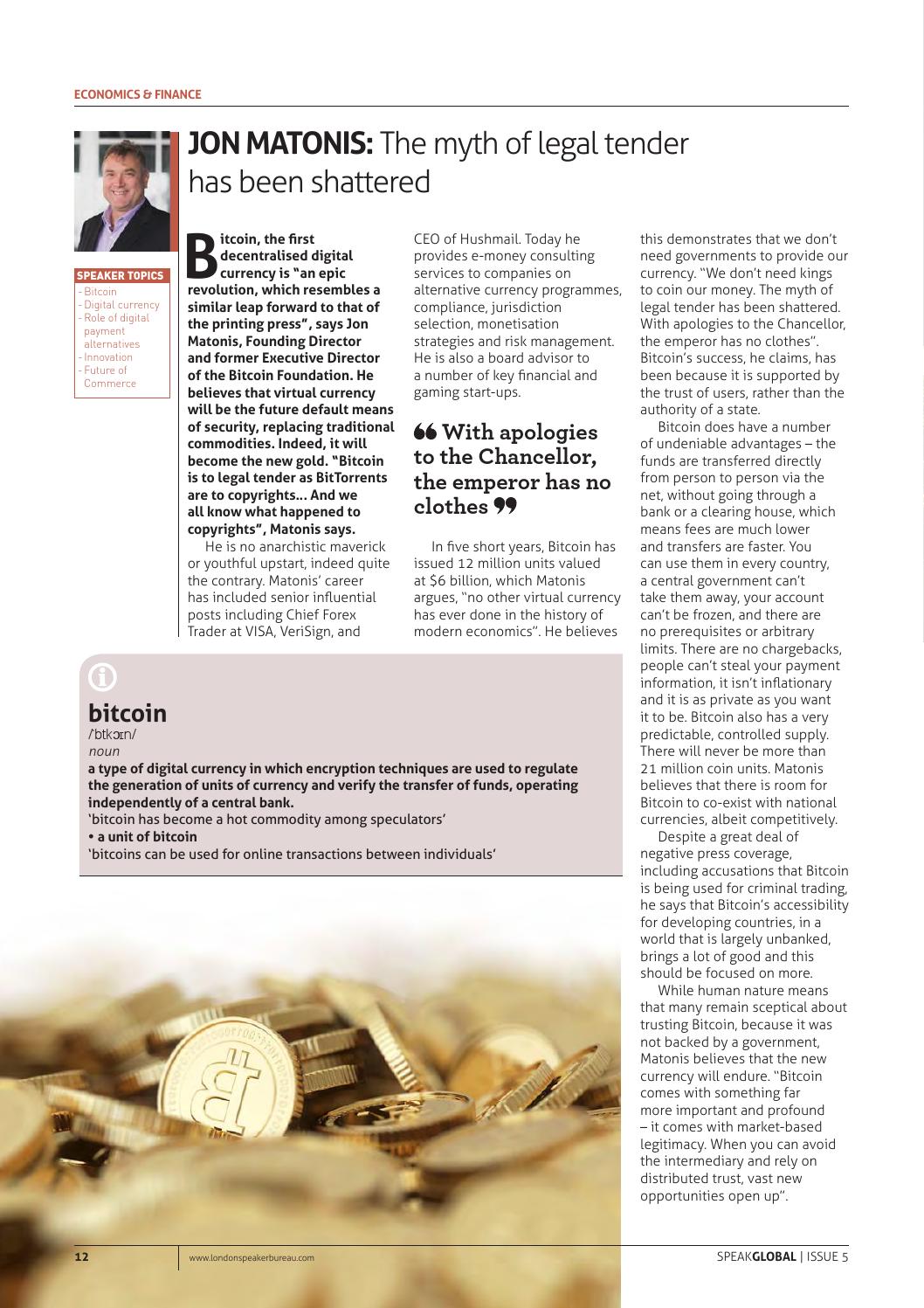
The Myth of Legal Tender Has Been Shattered

By SPEAKGLOBAL
Thursday, July 30, 2015


London Speaker Bureau - SPEAKGLOBAL Issue 5 (article appears on page 14):

Saturday, July 25, 2015

Cubits Welcomes Jon Matonis on Board of Directors

By Bitcoinist.net
Inside Bitcoins
Saturday, July 25, 2015

http://insidebitcoins.com/news/cubits-welcomes-jon-matonis-on-board-of-directors/33877


Cubits, known as “Europe's Gateway to Bitcoin”, is a company that offers instantaneous exchange of Bitcoin as well as the storing of Bitcoin through their wallet. With a 3-step process to purchase Bitcoin for new users, and with global availability (excluding the USA) through the 17 accepted currencies, Cubits is arguably one of the easiest methods to buy Bitcoin in and even outside of Europe.

That demand for Bitcoin is growing too. With tensions and uncertainty growing in the situation surrounding the Euro, more people are looking to alternative currencies like Bitcoin.
"We have seen tremendous growth in recent months that we attribute to continuing unease in the Eurozone. People are clearly searching for alternative ways to achieve some control over their funds and Cubits is meeting their needs” Tim Rehder, CEO, Cubits."
Cubits has recently adjusted their focus onto servicing the consumer market throughout Europe, which is supported by the fast verification provided by their new interface. Along with the website face-lift, Cubits has welcomed aboard Jon Matonis to its board of directors.

Jon Matonis, known most for his experience from being the executive direction of the Bitcoin Foundation, has also gained knowledge in both traditional and alternative financial industries due to his past positions at places like Sumitomo Bank, VeriSign, as well as being the CEO of Hushmail and the Chief Forex Trader at VISA. Julian Mautner, Founder of Cubits said:
“We are thrilled to welcome Jon Matonis to our board at this time of extraordinary growth. We share a vision for the future of blockchain-based financial industries and Jon’s experience and insight will be invaluable to the success of our team.”
Jon Matonis said, “Cubits was a simple choice for me. Their team has a proven track record with the right model to scale quickly in the current Bitcoin environment”.

Disclaimer: This article was provided by Bitcoin PR Buzz. Bitcoinist is not affiliated with Cubits and is not responsible for its products and/or services.

Wednesday, July 15, 2015

Bitcoin Is Sedition

By Justus Ranvier
Bitcoinism
Wednesday, June 11, 2014

https://bitcoinism.liberty.me/bitcoin-is-sedition/

The Reaction

Ever since the venture capital scene started talking about Bitcoin back in 2013, one of the most frequently cited comments from them is that Bitcoin is interesting for the technology, not the currency. In fact, this  mantra has become so common that it almost sounds… scripted.


The Problem

What’s going on here?

Apparently millions of Bitcoin users around the globe never got the word that Bitcoin isn’t interesting as a currency.   If Bitcoin wasn’t interesting as a currency, then why would the banking system need to go to such lengths to slow down the capital flight from the Dollar to Bitcoin by enacting restrictive Choke Point restrictions on both regular businesses and P2P trading?

The answer lies with the fate of the US Dollar. All government currencies have a finite life cycle, with an average lifespan of 27 years.  The USD has lasted longer than most, but it will not be an exception. However, whether you’re talking about the Weimar Germany, or Argentina, or the USSR, or the USA, the death of a currency follows an known script. The most important part of this script is that the connected elites get out first and leave the rest of the population to be the bagholders.

The problem with Bitcoin is that goes off-script. The hoi polloi got into Bitcoin before the elites got into it, and Bitcoin contains none of the mechanisms via which they normally arbitrarily inflate the currency to enrich themselves. This is a problem if you’re part of the modern financial aristocracy. Something Must Be Done.

Tuesday, April 14, 2015

Former Bitcoin Foundation Director Joins Board of First Global Credit

By Christie Harkin
Bitcoin Magazine
Tuesday, April 14, 2015

https://bitcoinmagazine.com/articles/former-bitcoin-foundation-director-jon-matonis-joins-board-first-global-credit-1429046155


Jon Matonis has joined First Global Credit Board as a non-executive director where he will play an advisory role related to strategic direction, security, due diligence and other matters.

First Global Credit is a finance company that focuses exclusively on digital currency products. Its aim is to bridge the gap between bitcoin and fiat currencies through trading services, debt instruments, merchant services and other strategies.

In a press statement, Gavin Smith, chief executive and founding director of First Global Credit said, “We are delighted to welcome Jon to the board; we have found we share a mutual vision for both the future of bitcoin and how First Global Credit will fit into that ecosystem. Jon’s comprehensive knowledge and connections within the Bitcoin community will be extremely beneficial to the growth and development of the business.”

Matonis, a founding board member and former executive director of the Bitcoin Foundation, has an extensive career in finance and Bitcoin. His resume includes prior positions as CEO of HushMail and Director of Financial Services at VeriSign. A high-profile figure and thought leader in the digital currency community, he also serves on the boards or advisory boards of several other companies in the space, including BitGame Labs, BitPay, GoCoin and CoinDesk.

“There are a lot of companies that maintain bitcoin on their books,” Matonis said in an interview with Bitcoin Magazine. “Those bitcoins usually sit there dormant or even depreciating in value. What First Global does is offer to collateralize those bitcoins so that they can actually get a return.”

Matonis gave the example of online gaming. Traditional casino operators are able to get a return on their floats. But up until now, bitcoin casinos have not been able to do this. First Global offers them an opportunity to generate a yield, said Matonis.

“I’m also excited by the ability to use bitcoin assets as collateral for trading in the futures and options markets,” Matonis added. “Currently, T-bills can be used as collateral on various exchanges, but no one has structured it with bitcoin. First Global Credit plans to add futures markets as one of the markets available via their program.”

“Jon has the big picture,” said Marcie Terman, communications director for First Global. “He has the Bitcoin background and the financial background. He can look at our systems and make sure they are as robust as possible. It will be great to have him as a resource to speak on our behalf with government bodies.

Matonis has presented at conferences across the world on bitcoin and its disruptive economic implications to a wide variety of audiences, including members of the Federal Reserve, Bank of England, European Central Bank, SWIFT, IRS, DHS, payment networks, major financial institutions,, hedge funds and family offices.

Terman also expressed a hope that Matonis would be helpful in bringing in outside financing as the company starts to look outward for equity participation.

“The Bitcoin market is at a pivotal stage in its development,” Matonis said "Having been adopted as a transaction currency by many, the next necessary step in bitcoin’s evolution is to prove itself as a true investment vehicle, an instrument with a fully functioning capital market."

Other announcements:
http://bitcoinist.net/first-global-credit-jon-matonis-non-executive-director/

http://insidebitcoins.com/news/first-global-credit-appoints-jon-matonis-non-executive-director/31748

http://www.financemagnates.com/executives/move/former-bitcoin-foundation-exec-jon-matonis-joins-first-global-credit/

http://www.coinfox.info/news/persons/1856-jon-matonis-joins-first-global-credit-as-a-non-executive-director

Thursday, March 19, 2015

Bitcoin and iGaming: Disruption Comes From Your Blind Spot

By Jon Matonis
CoinDesk
Saturday, March 14, 2015

http://www.coindesk.com/bitcoin-and-igaming-disruption-comes-from-your-blind-spot/

It has often been said that bitcoin is the ideal digital casino chip. But what does that really mean?

For starters, it means that online gaming, more than anything else, is all about the customer experience.

Whether it's a land-based casino or an online casino, gamblers want a seamless experience with immediacy and privacy, and operators want an irreversible payment method. Bitcoin provides all three.

I recently made the prediction that within five years, half of the top 10 iGaming operators will be bitcoin-only.

Of course, the mainstream online casino operators don't see it that way and I wouldn't expect them to. They have a profitable and expanding business model with national fiat currencies. Why would they want to disrupt that revenue stream?

Funny thing about disruption though is that it rarely comes from within. Disruption comes from your blind spot.

While major iGaming and industry gambling conferences in the west have paid lip service to bitcoin and cryptocurrencies as alternative payment methods, they have simultaneously relegated it to a niche solution where presentations are neatly tucked away in a side corner. Kodak did the same thing after surprisingly inventing the first digital camera in 1975.

Reshaping the iGaming market

The grand opportunity with bitcoin is not with the major operators, which is exactly why I predict that half of the top 10 iGaming operators will soon be bitcoin-only.

New bitcoin gambling operations will evolve in that way organically – they will not be the major operators of today shedding their national fiat currency businesses. It will occur more along the lines of how Sony and Canon exploited Kodak's weak spot.

The major differences between bitcoin-only operators and the majors are a stark reminder of how complacency for something unusual and new can threaten an entire business model. The differences are revolutionizing the playing field.

For instance, bitcoin operators do not need to maintain a bank account anywhere in the world. If structured carefully, operating expenses can be covered entirely in bitcoin, including salaries and even real-time payouts to the all-important affiliates.

Provably fair cryptographic techniques for casinos, like those deployed at SatoshiDice, eliminate the need for eCOGRA-type bodies to provide legitimacy and credibility.

And probably most important, solving the payment dilemma in parts of the world under-served by banks or restricted by traditional payment networks opens up the world's vast unregulated gambling markets.

While some licensed and national currency gambling sites attempt to push funding compliance to bitcoin wallet providers, other gambling sites are moving forward now by accepting bitcoin directly from customers. Indeed, bitcoin's strengths and speed-to-market play very well in this fertile and untapped ground.

These startling innovations will likely reshape the market for iGaming around the world, creating a new set of skills required for the industry, but that is not yet realized by today's mainstream market leaders.

The management team decisions that bitcoin operators need to be focused on include:
  • In-house vs outsourced payment processing
  • Hot wallet/cold wallet ratios to balance customer service and ultimate security
  • Providing direct or indirect methods for customers to acquire bitcoin
  • The percentage of operational assets held in bitcoin vs national currency
  • Hedging and float yield strategies for bitcoin company assets

Blockchain tech is the cutting edge

With the bitcoin network just a little over six years old, the current statistics related specifically to bitcoin and gaming are impressive.

One hundred percent of the world's countries can be reached via the bitcoin payment option and no other payment method can make that claim. It has been estimated by Coinometrics and others that approximately 40% of bitcoin network transaction volume is related to payments for online gaming. Bitcoin-only casino operators lead the field for the bitcoin-related web advertising market. And, there are over 150 bitcoin-only casinos and gambling sites operating today.

AnoniBet claims to be the "first bitcoin sportsbook and casino" operating since 2011 and the original SatoshiDice pioneered the field of blockchain betting.

Since the field is moving so rapidly, bitcoin gambling directories and lists have sprung up, with sites like my favorite Bitcoin Gambling Sites and the more objective Bitcoin Gambling Wiki. Some bitcoin gambling sites are simply too new to be listed, such as BurnTurn poker and the promising Augur project for a decentralized prediction market.

If you want to see where the innovation in gaming occurs today, the bitcoin and blockchain sector is the place to look.

Taking the lead

My advice to bitcoin gaming businesses? Ignore the regulators.

By that I mean the gaming commission regulators at least while the industry is in a grey area. They don't know what they are doing with respect to bitcoin and, out of apathy, they frequently push the opportunity to the financial regulators who end up delaying implementation.

Bitcoin suffers from an outright usage ban or threatened ban in only three countries: Bolivia, Ecuador and Russia, which is still considering the final ban legislation, but blocks access to bitcoin-related websites in the meantime.

Regulators are not leaders, they are followers. Don't count on them to be insightful and innovative. Their primary job is to slow you down.

Do what you do best and build lasting and profitable businesses. Maybe even launch a skunkworks business within your organization. Failing that, perhaps acquire one of many bitcoin-only gambling operators from the industry lists above. Ultimately, it may assist in the upcoming drive to remain relevant.

Jon Matonis recently presented at a bitcoin seminar and a cryptocurrency regulatory compliance panel both for ICE. He is scheduled to make a presentation called "State of the Market for Bitcoin in Gambling" at his first iGaming conference in Asia on 19th March 2015.